

Celebration of the victory of the Battle of Lepanto, Post 1571
Jacopo Negretti (called Palma the Younger)
Brief description of the interventions
The restoration of the monumental painting involved the Painting on Canvas Laboratory for almost two years: as many as 10 restorers, alongside diagnostic experts and art historians, tackled the complex intervention, a case of particular interest for the treatment of large-format canvases and with a compelling history still partly to be reconstructed.
The canvas was commissioned to the artist, along with another large work depicting The Souls of Purgatory, for the chapel of the Rosary in the church of San Domenico in Brescia (destroyed in 1883) and landed, presumably at the end of the nineteenth century, among the collections of the Marquis Silvio della Valle di Casanova and his wife Sophie Browne, preserved in the Villa San Remigio di Pallanza.
In 1977 the Piedmont Region acquired the real estate, landscape and artistic heritage of the family and only in recent years it has been possible to identify and rediscover the masterpiece of Palma il Giovane, which was thought to be missing. Perhaps the adaptation to the wall of the historic Music Room of the Villa has led to the reduction of the upper half of the canvas.
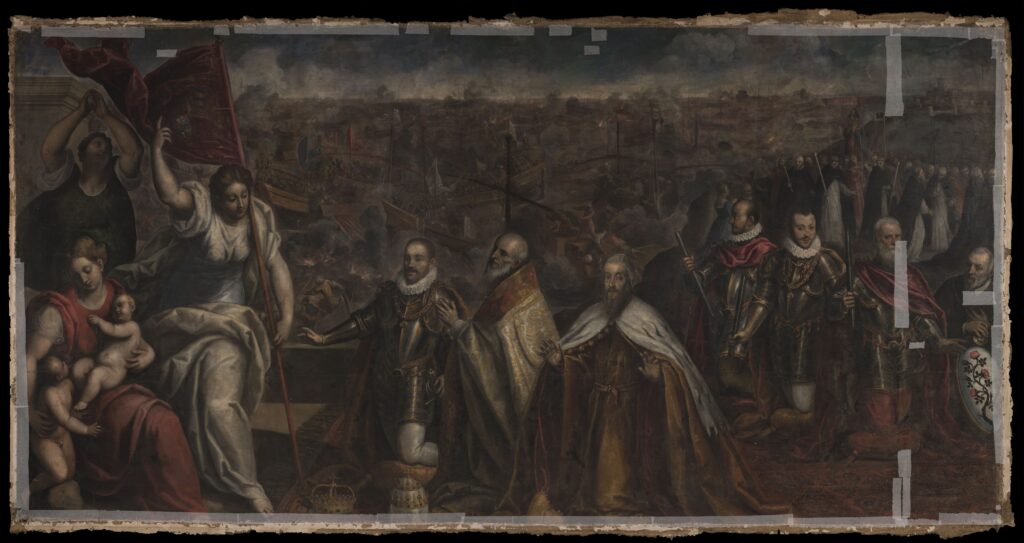
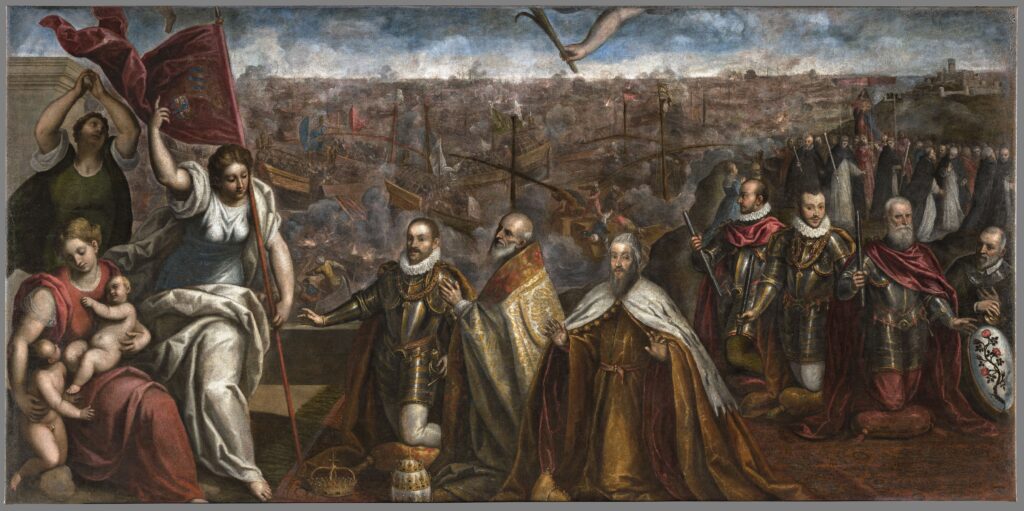
The vertical tripartition of the pictorial space designed by the artist is based on the repetition of three figures: starting from the left, the three Theological Virtues (Charity, Hope and Faith), in the centre, the three promoters of the Holy League, Philip II King of Spain, Pope Pius V and Alvise I Mocenigo Doge of Venice, and the three admirals who won the Muslim fleet in the Gulf of Corinth, Marcantonio II Colonna, Don Giovanni d’Austria and Sebastiano Venier. On the far right you can also see a self-portrait of Palma.
In the upper part, which was lost, a host of angels, the Virgin, the Trinity and Saint Justina, patron saint of the event, were depicted in the open air on clouds.
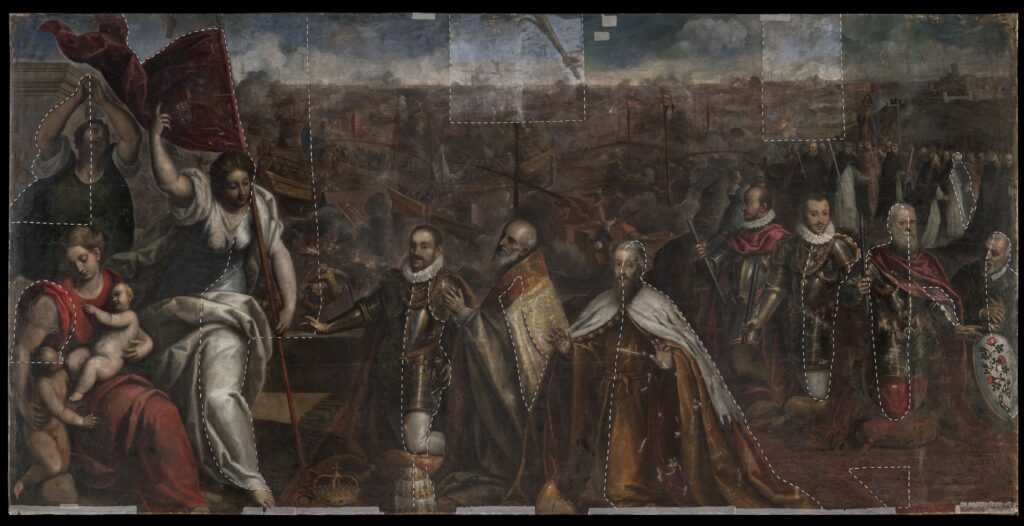
Thanks to the preliminary study, important data emerged on the conservative history of the painting that immediately showed the signs of previous interventions and substantial alterations suffered over time, first of all the downsizing in height that deprived it of the upper half. Moreover, with the first cleaning tests, under a recent repainting that affected the sky, figurative details deliberately concealed and attributable to the lost portion, now visible on the upper edge of the work, emerged.
The work had already been lined during a previous intervention: it was decided to keep the lining, still in good condition, and to create a new wooden frame, with a harmonious tensioning system that accommodates the natural dimensional variations of the large canvas.



 CCR and accessibility


